

Your domain name is the front door to your small business online. It's the first thing customers type into their browser, the anchor of your email address, and a core part of your brand identity. According to Verisign's Domain Name Industry Brief, there are over 350 million registered domain names worldwide, which means finding the right one for your business requires strategy, not just luck.
Whether you're launching a local bakery, a consulting firm, or an e-commerce store, the domain you pick will follow your business for years to come. This guide walks you through a proven process for choosing a domain name that's memorable, brandable, and available.
Why Your Small Business Domain Name Matters
A study by GrowthBadger found that 77% of consumers use a company's domain name or URL to judge its credibility. For small businesses especially, your domain is one of your first opportunities to build trust. An unprofessional or confusing domain can send potential customers straight to a competitor.
- First impressions: Customers see your domain before they see your website. A clean, relevant domain signals professionalism.
- Brand recognition: Your domain reinforces your brand name every time someone types it, shares it, or sees it in search results.
- Email credibility: Having info@yourbusiness.com is far more professional than using a Gmail or Yahoo address, according to Barracuda's Email Threat Research.
- Search visibility: While Google's John Mueller has confirmed that exact-match domains no longer get a direct SEO boost, a relevant domain still helps users understand what your site offers.
Step 1: Start with Your Business Name
The simplest approach is to use your actual business name as your domain. If your business is called 'Portland Bread Company,' try portlandbreadcompany.com first. Shopify's business naming guide recommends keeping your domain as close to your official business name as possible to avoid customer confusion.
If the exact name is taken, try slight variations: portlandbread.com, portlandbreadco.com, or even getportlandbread.com. Avoid hyphens and numbers. They're hard to communicate verbally and look unprofessional.
Step 2: Keep It Short, Simple, and Memorable
Research from DataGenetics shows that the average .com domain is 12 characters long. Shorter domains are easier to type, less prone to typos, and more memorable. Aim for 6–14 characters if possible.
- Avoid complex spelling or uncommon words that customers might misspell
- Skip hyphens, numbers, and double letters (e.g., pressservice.com is confusing)
- Test by saying it out loud: if you have to spell it out, it's too complex
- Ask a friend to type it after hearing it once, the 'radio test'
Step 3: Choose the Right TLD (Top-Level Domain)
For most small businesses, .com is still the gold standard. According to W3Techs, .com accounts for roughly 47% of all websites. Customers instinctively add .com when typing a URL, so owning the .com version of your name eliminates confusion.
That said, newer TLDs can work well for specific use cases. Google's .app and .dev TLDs come with built-in HTTPS security via HSTS preloading. .co has become popular among startups. Companies like angel.co (now Wellfound) helped legitimize it. If .com isn't available, .co, .io, or an industry-specific TLD like .cafe or .bakery can be viable for local businesses.
Step 4: Check Availability and Social Media Handles
Before you fall in love with a name, verify it's actually available. Tools like domhaul let you check domain availability across multiple TLDs simultaneously. This saves you from the frustrating process of checking names one by one on individual registrar sites.
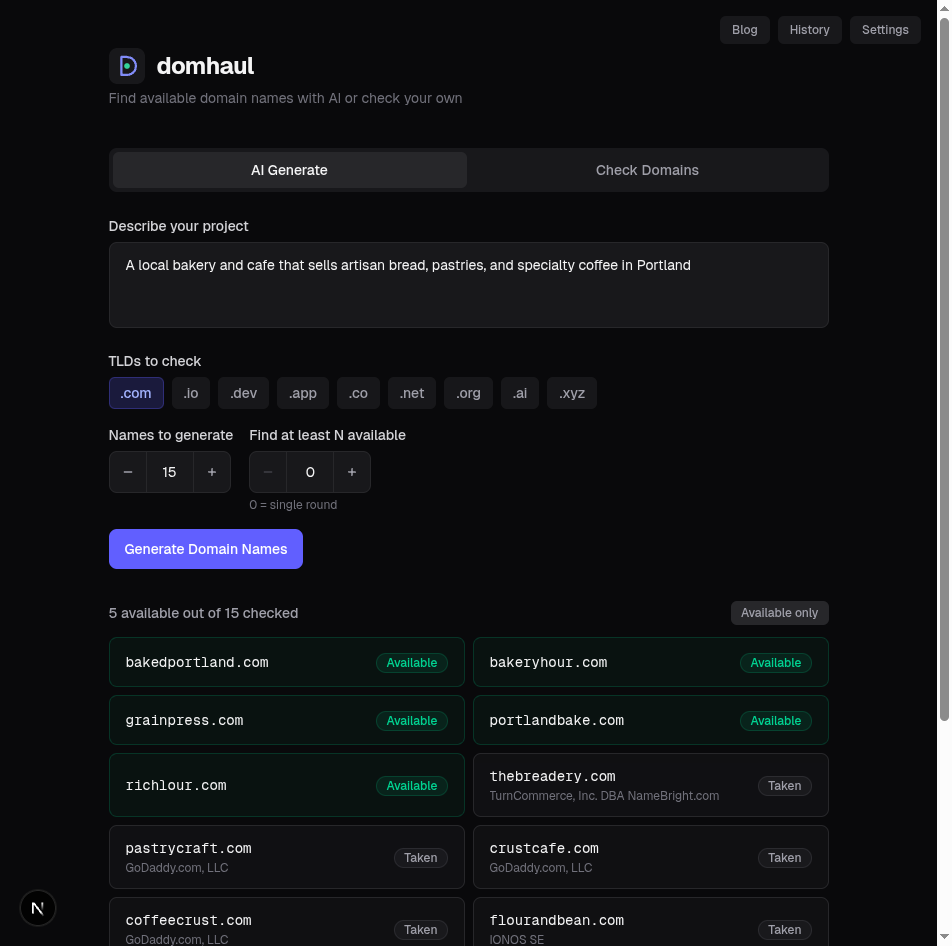
Beyond domain availability, check that matching social media handles are open on platforms relevant to your business. Tools like Namechk and KnowEm let you search hundreds of platforms at once. Having consistent branding across your domain and social profiles builds recognition and trust.
Step 5: Avoid Trademark Conflicts
Using a domain name that infringes on an existing trademark can lead to costly legal disputes. The UDRP (Uniform Domain-Name Dispute-Resolution Policy), administered by WIPO (World Intellectual Property Organization), handles thousands of domain disputes annually. In 2024 alone, WIPO processed over 6,000 cases.
- Search the USPTO's TESS database (United States Patent and Trademark Office) for existing trademarks
- Check the EUIPO database if you operate in Europe
- Google the name thoroughly to find any existing businesses using it
- Consider consulting a trademark attorney if you plan to invest heavily in the brand
Step 6: Think Long-Term
Your domain name should be able to grow with your business. A name like 'portlandbread.com' works well for a bakery, but what if you expand into catering or open locations in other cities? Harvard Business Review has noted that overly narrow brand names can limit a company's perceived scope as it grows.
Consider a slightly broader name that gives you room to expand. Amazon started as an online bookstore but chose a name that wasn't tied to books. Conversely, if you're confident in your niche, a specific name can help with SEO and positioning.
Common Small Business Domain Mistakes
- Using a free subdomain: yourbusiness.wordpress.com or yourbusiness.wixsite.com looks unprofessional. A custom domain costs as little as $8–12/year through registrars like Cloudflare, Porkbun, or Namecheap.
- Choosing a long, forgettable name: bestartisanbreadandcoffeeinportland.com won't fit on a business card, let alone stick in anyone's memory.
- Not securing multiple TLDs: If you buy yourbusiness.com, consider also buying .net and .co to prevent competitors or squatters from confusing your customers.
- Ignoring renewals: Domains expire if you don't renew them. ICANN requires registrars to send renewal notices, but it's smart to enable auto-renewal to avoid accidentally losing your domain.
- Waiting too long: Good domains get registered every day. If you find one you love, register it immediately. Domain squatters and automated bots move fast.
Ready to Find Your Business Domain?
Choosing a domain name doesn't have to be stressful. Start by brainstorming names that reflect your brand, keep them short and memorable, and use a tool like domhaul to check availability across multiple TLDs at once. With AI-powered suggestions, you can discover creative domain options you might never have thought of on your own.
How much does a domain name cost for a small business?
Standard .com domains typically cost $8–15/year through registrars like Cloudflare, Porkbun, or Namecheap. Premium or aftermarket domains can range from $100 to tens of thousands of dollars depending on the name's desirability and length.
Should my domain name match my business name exactly?
Ideally, yes. An exact match between your business name and domain reduces customer confusion and strengthens brand consistency. If the exact match isn't available, use a close variation rather than a completely different name.
Is .com the only TLD worth using for a small business?
.com is the most recognized and trusted TLD, but alternatives like .co, .shop, .store, and industry-specific extensions can work well for small businesses. The key is choosing something customers will remember and trust.
What should I do if my preferred domain name is taken?
Try variations like adding 'get,' 'try,' or 'my' before the name. You can also try a different TLD (.co, .io, .shop), or use an AI domain generator like domhaul to brainstorm creative alternatives. If the domain is parked or for sale, you can try negotiating through the registrar.
Can I change my domain name later without hurting my business?
You can, but it's costly and disruptive. You'll need to set up proper 301 redirects, update all marketing materials, notify search engines, and wait for your new domain to build authority. It's much better to choose the right domain from the start.