

How does domain name affect SEO in 2026? It's one of the most debated topics in SEO. The short answer: your domain name matters, but not in the way most people think. Google's algorithms have evolved far beyond simple keyword matching, and understanding the real relationship between domains and rankings, based on Google's official guidelines and current ranking factor research, can help you make smarter decisions.
How Does Domain Name Affect SEO in 2026? Quick Answer
Per Google's 2026 Search Central guidelines, the domain name itself is not a direct ranking factor. What Google ranks is the content, links, user signals, and technical health of the pages on that domain. Your domain influences SEO indirectly through:
- Brand recognition: branded queries boost overall authority
- Click-through rate: clean, trustworthy domains get more clicks from search results
- HTTPS enforcement: TLDs like .app and .dev force HTTPS, which Google confirms as a ranking signal
- Backlink history: a domain's prior backlink profile can help or hurt rankings
- Geo-targeting: country-code TLDs (.uk, .de) signal regional intent
What does not directly affect SEO in 2026: keywords in domain, domain age (alone), TLD choice for gTLDs (.com vs .io vs .app rank equally), or domain length. The rest of this guide breaks down each factor with Google's exact statements and current data.
The End of Exact Match Domain (EMD) Dominance
In the early days of search, exact match domains (EMDs) like cheapflights.com or besthotels.com could rank well simply because the keywords were in the domain. Google's EMD Update, first rolled out in September 2012, specifically targeted low-quality sites that relied on exact match domains to rank without providing genuine value.
Google's John Mueller has confirmed multiple times on social media and in webmaster hangouts that having keywords in your domain name does not provide a ranking boost in itself. However, he also acknowledged that users may be more likely to click on a domain that clearly signals relevance to their search, which indirectly helps rankings through improved click-through rates.
How Your Domain Name Actually Impacts SEO
While keywords in domains aren't a direct ranking factor, your domain name influences several signals that Google does care about:
1. Brand Signals and Authority
Google's algorithms increasingly favor brands. A Semrush study on ranking factors found that branded searches (people searching specifically for your brand name) correlate strongly with higher overall rankings. A memorable, brandable domain name encourages branded searches, which signals to Google that your site is an established entity.
Think about it: domains like stripe.com, notion.com, and canva.com don't contain keywords related to their products, yet they dominate search results because they've built strong brand authority. Your domain is the foundation of your brand's online identity.
2. Click-Through Rate (CTR) in Search Results
Your domain appears in every search result snippet. According to Backlinko's analysis of 5 million search results, higher click-through rates correlate with higher rankings. A clean, trustworthy domain can improve CTR in two ways:
- Users are more likely to click on a recognizable, professional-looking URL
- A domain that clearly relates to the search query provides a relevance signal to the user, even if Google doesn't use it algorithmically
3. Domain Age and History
Google's Matt Cutts (former head of web spam) stated that the difference between a domain that's six months old and one year old is minimal. However, Ahrefs' study on ranking factors found that the average age of a page ranking in the top 10 of Google is over 2 years old. This doesn't mean older domains automatically rank better. It means building authority takes time regardless of your domain.
What matters more than age is the domain's history. A domain previously used for spam or black-hat SEO can carry penalties that are difficult to recover from. Before buying an existing domain, check its history using the Wayback Machine (web.archive.org) and run it through tools like Ahrefs or Moz to check for spammy backlink profiles.
4. TLD Impact on Rankings
Google's John Mueller has stated that all TLDs are treated equally in search: a .io or .app domain has no inherent disadvantage compared to .com. However, country-code TLDs (ccTLDs) like .uk, .de, or .ca may receive a geo-targeting signal. According to Google's Search Central documentation, ccTLDs help Google understand which country your content is intended for.
For global audiences, .com remains the safest choice. Search Engine Journal research shows that users in most countries trust .com domains more than alternatives, which can indirectly affect CTR and engagement, both signals Google considers.
5. Domain Length and User Behavior
While domain length isn't a direct ranking factor, shorter domains benefit from better user experience. A Microsoft Research study on URL readability found that users prefer shorter, cleaner URLs and are more likely to trust and share them. Since backlinks and social signals contribute to SEO, a shareable domain indirectly helps your rankings.
Domain Name SEO Best Practices for 2026
- Prioritize brandability over keywords: Choose a domain that builds a memorable brand rather than stuffing keywords. Airbnb.com outperforms bestshorttermapartmentrentals.com because brand equity compounds over time.
- Keep it short and clean: Under 15 characters is ideal. Avoid hyphens, numbers, and double letters that cause confusion and typos.
- Match your domain to user intent: Your domain should give users a general sense of what your site offers, even without keywords. A domain like healthline.com clearly signals health content without being a keyword-stuffed EMD.
- Secure HTTPS: Google confirmed HTTPS as a ranking signal back in 2014, and it's now table stakes. All major registrars and hosting providers offer free SSL via Let's Encrypt. TLDs like .app and .dev enforce HTTPS automatically via HSTS preloading.
- Check for penalties before buying: If purchasing an existing domain, audit its backlink profile with Ahrefs, Semrush, or Moz Link Explorer. A domain with spammy links can actually hurt your rankings.
- Build authority on one domain: Rather than spreading content across multiple domains, consolidate on a single strong domain. Moz's Domain Authority metric rewards sustained content investment on one domain over fragmented efforts across many.
What Google Actually Cares About
In 2026, Google's ranking factors are increasingly centered on E-E-A-T (Experience, Expertise, Authoritativeness, Trustworthiness), as outlined in Google's Search Quality Rater Guidelines. Your domain is one piece of a much larger puzzle. The most impactful factors remain:
- Content quality: Comprehensive, original content that satisfies user intent
- Backlinks: Links from authoritative, relevant websites signal trust to Google
- User experience: Fast load times, mobile responsiveness, and Core Web Vitals
- Technical SEO: Proper indexing, structured data, XML sitemaps, and clean site architecture
- Topical authority: Consistently publishing expert content in your niche builds authority signals that Google rewards
Choose a Domain That Grows with Your Brand
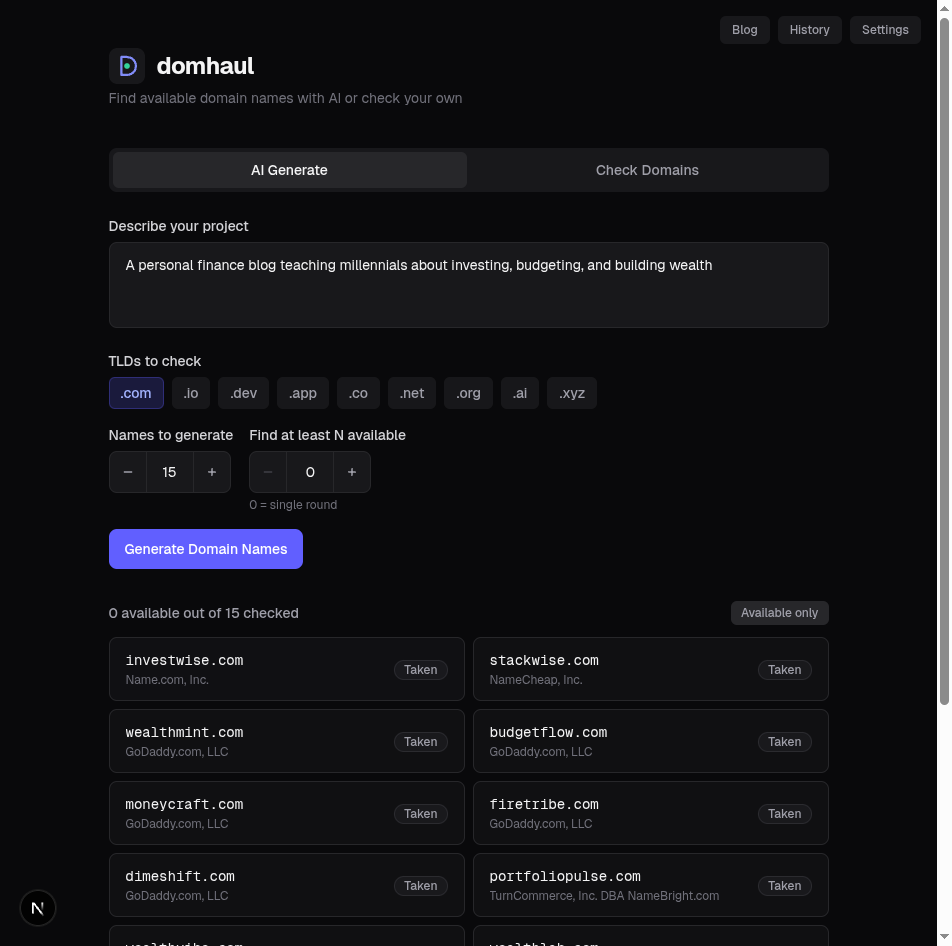
The best domain for SEO is one that builds a strong brand, is easy to remember and type, and serves as a stable foundation for years of content investment. Use domhaul to brainstorm brandable domain ideas and check availability across multiple TLDs, finding the perfect balance between creativity and availability.
How does domain name affect SEO in 2026?
In 2026, domain names affect SEO indirectly. Per Google's Search Central guidelines, keywords in a domain are not a direct ranking factor. What matters is the brand recognition your domain builds, the click-through rate it earns in search results, and the backlink profile it accumulates. HTTPS (enforced on .app and .dev) is a confirmed ranking signal, and country-code TLDs help with geo-targeting. Domain age, length, and TLD choice between gTLDs have minimal direct impact.
What do Google's guidelines say about domain names and SEO?
Google's Search Central documentation and statements from John Mueller confirm that all gTLDs are treated equally, keywords in domains don't provide a ranking boost, and domain age alone is not a significant factor. Google's official position is that content quality, backlinks, user experience, and E-E-A-T (Experience, Expertise, Authoritativeness, Trustworthiness) are the primary ranking factors, not the domain name itself.
Do keywords in a domain name help with SEO?
Not directly. Google's John Mueller has confirmed that keywords in domains don't provide an inherent ranking advantage. However, a relevant domain can improve click-through rates in search results, which indirectly helps rankings. Focus on brandability rather than keyword stuffing your domain.
Does the .com TLD rank better than other TLDs?
Google has stated that all gTLDs (.com, .io, .app, .dev, etc.) are treated equally in rankings. However, .com domains often receive higher click-through rates because users trust and recognize them more. Country-code TLDs (.uk, .de) may receive geo-targeting signals.
Should I buy an old domain for SEO benefits?
An aged domain with clean backlinks and relevant history can give you a head start, but it's not a shortcut. If the domain has a spammy history, it can actually hurt your rankings. Always check the backlink profile and Wayback Machine history before purchasing an existing domain.
How does domain age affect SEO rankings?
Domain age alone isn't a significant ranking factor. Google's Matt Cutts stated the difference between a 6-month and 1-year-old domain is minimal. What matters more is the quality and consistency of content published on the domain over time. Authority is built through sustained effort, not simply by having an old domain.
Is it better to have a branded domain or keyword domain?
In 2026, branded domains are generally more effective for long-term SEO. Google's algorithms favor brand signals, and a memorable brand generates the direct searches, social shares, and natural backlinks that drive rankings. Keyword domains can still work in narrow niches but shouldn't be relied upon as an SEO strategy.