

If you've spent any time around startups, GitHub, or developer Twitter, you've seen the .io extension everywhere: github.io, socket.io, itch.io, codecov.io. So what domain is .io, exactly, and where did it come from? The short answer:
But the technical answer doesn't explain why a tiny, uninhabited British territory ended up powering the domain names of some of the most valuable startups in the world. This guide walks through the full story: the origin of .io, why tech companies grabbed it, what the recent Chagos Islands sovereignty agreement means, and whether you should register one in 2026.
Where Does the .io Extension Come From?
Every two-letter top-level domain (like .us, .uk, .de, .jp) is a country-code TLD, assigned according to the ISO 3166-1 alpha-2 standard. The Internet Assigned Numbers Authority (IANA) delegates each ccTLD to a registry that manages it on behalf of the country or territory.
The IO code is assigned to the British Indian Ocean Territory (BIOT), a UK overseas territory roughly halfway between East Africa and Indonesia. The territory consists of the Chagos Archipelago, of which Diego Garcia is the largest island and hosts a major joint UK–US military base. The civilian population was removed in the late 1960s and 1970s, so today the territory has no permanent residents.
According to IANA's root zone database, the .io TLD was delegated in September 1997. For most of its history it was operated by a British company called Internet Computer Bureau (ICB). In 2017, ICB was acquired by Afilias, which later rebranded to Identity Digital, the current registry operator.
Why "I/O" Stuck With Programmers
On paper, .io is just a country code that almost no end users in BIOT actually use. So why does every developer-focused product seem to grab one? Two reasons, and they reinforced each other over time.
1. "I/O" means input/output
In computing, I/O is the shorthand for input/output: reading from a disk, writing to a network socket, handling keyboard input, sending packets, anything that crosses the boundary between a program and the outside world. For developers, ".io" reads as a tech-native abbreviation, not a country code. The domain feels like it was made for software products, even though that wasn't its original purpose.
2. Short names were still available
By the early 2010s, almost every short, brandable .com was either taken, parked, or on the aftermarket for five to six figures. .io offered a way out: the same two-syllable name that cost $20,000 on .com might be a $35 registration on .io. Y Combinator startups picked it up, GitHub launched github.io for project pages in 2008, and the trend snowballed.
Once enough recognizable companies (itch.io, socket.io, hackernoon.io, codecov.io) built brands on .io, the extension stopped feeling alternative. In developer and startup circles it became a normal default, alongside .com.
Notable Companies and Projects on .io
- github.io: GitHub Pages hosting for project sites and docs.
- itch.io: the dominant indie game marketplace.
- socket.io: the real-time WebSocket library used in countless production apps.
- codecov.io: code coverage tooling, now part of Sentry.
- sentry.io: application monitoring and error tracking.
- hashnode.io: developer blogging platform.
- agar.io: the breakout multiplayer browser game that helped popularize the ".io game" genre.
The .io game genre is itself a cultural artifact of the TLD's tech reputation. agar.io launched in 2015 and was so successful that dozens of imitators followed, and "io game" became a recognized category on YouTube and game portals. None of these games have anything to do with the British Indian Ocean Territory. They just inherited the .io halo.
What About the 2024 Chagos Islands Agreement?
In October 2024, the UK and Mauritius announced an agreement under which the UK would transfer sovereignty of the Chagos Archipelago to Mauritius, while retaining a long-term lease on the military base at Diego Garcia. This was big news for the .io domain because, in principle, transferring sovereignty of a territory can affect its ISO country code, and therefore its ccTLD.
Past examples: when the Soviet Union dissolved, the .su domain was supposed to be retired. When Yugoslavia broke up, .yu was eventually phased out. These transitions happen on long timelines (.su technically still resolves decades later), but they show that ccTLD changes are not theoretical.
For .io specifically, the situation is more nuanced than headlines suggested. The agreement preserves UK administration of Diego Garcia. Even if BIOT's ISO 3166 code is eventually retired, ICANN has an established five-year retirement process for ccTLDs, and there is overwhelming commercial and operational pressure to keep .io live given the scale of its adoption.
How Much Does a .io Domain Cost?
Standard .io registrations typically run $30–$60 per year, depending on the registrar. That's roughly 2–4× the cost of a comparable .com. Premium .io domains (short, common-word names) can cost anywhere from a few hundred to tens of thousands of dollars on the aftermarket.
- Standard registration: $30–$60/year at mainstream registrars (Namecheap, Porkbun, Cloudflare, Gandi, Google Domains successor Squarespace Domains).
- Renewal: roughly the same as registration price, and .io rarely has the steep renewal jumps you see on some other ccTLDs.
- Premium / aftermarket: short, dictionary-word .io names regularly trade for $1,000–$50,000+.
For a deeper price comparison across .com, .io, .app, .dev, .co, and .ai, see our breakdown in .com vs .io vs .app vs .dev: Which Domain Extension Should You Choose?.
Is .io Good for SEO?
Google has stated repeatedly that generic TLDs and ccTLDs used as generic TLDs are treated the same in search rankings. John Mueller, Google's Search Advocate, has confirmed this in multiple public statements (see this Search Engine Journal summary).
There's a useful subtlety: most ccTLDs are geo-targeted by default: .de signals Germany, .fr signals France. But Google treats .io as a generic gTLD, meaning it doesn't get auto-targeted to BIOT. You can rank globally on .io exactly as you would on .com. For a deeper walkthrough of how domain choice affects rankings, see Domain Name SEO: How Your Domain Affects Search Rankings.
When .io Makes Sense, and When It Doesn't
Good fit for .io
- Developer tools and SaaS: your audience reads .io as a positive signal.
- Open-source projects: pairs naturally with a GitHub-centric workflow.
- APIs and infrastructure products: the .io = I/O association does real branding work.
- Startups where the .com is taken or expensive: .io is the most-accepted alternative in tech.
Weaker fit for .io
- Consumer brands: most non-technical users still default to typing .com.
- Local businesses: a .com or country ccTLD (e.g., .co.uk) carries more local trust.
- Anything aimed at older or non-tech demographics: .io may register as unfamiliar or untrusted.
- Brands that need maximum long-term certainty: given the BIOT sovereignty situation, very long-horizon investments may prefer a gTLD like .com, .app, or .dev.
Should You Also Buy the .com?
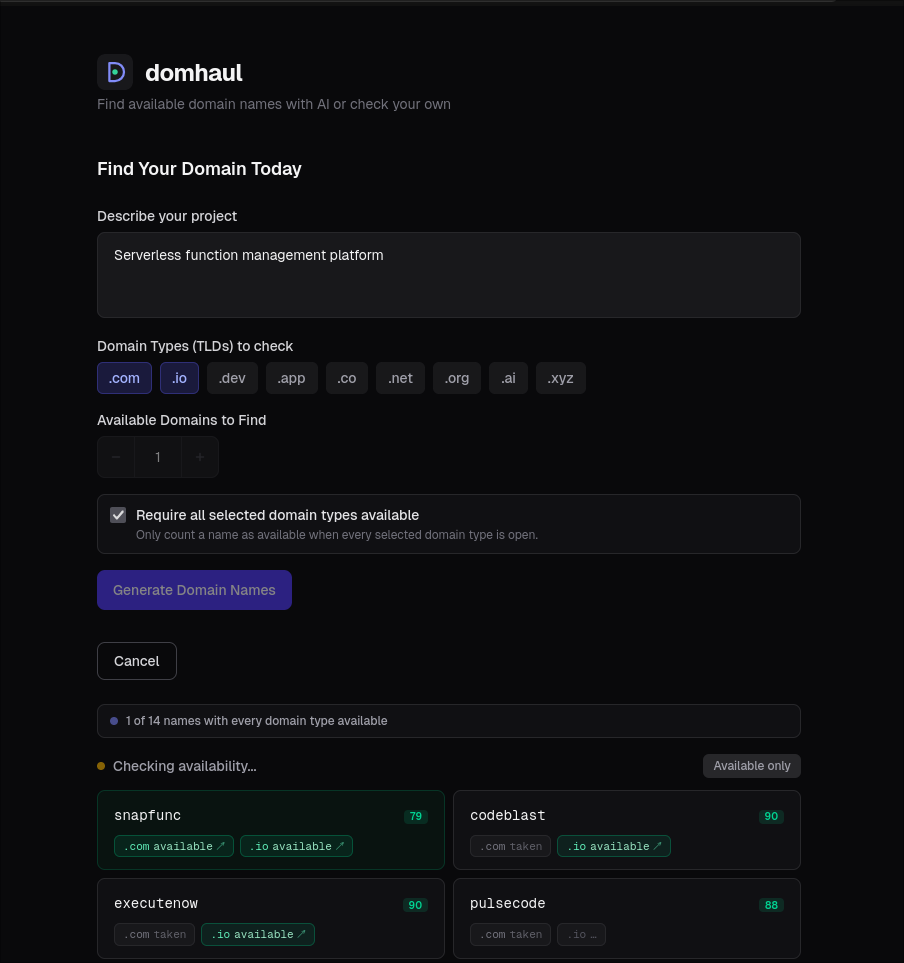
If your brand is large enough to attract type-in traffic, yes: secure the matching .com and redirect it to your .io if possible. Users habitually append ".com" when they can't remember an extension, and you do not want that traffic landing on a squatter, a competitor, or a parked page. Plenty of well-known companies on .io also own the .com defensively.
The simplest way to compare what's available is to check multiple extensions for the same name at once:
Frequently Asked Questions
What country does the .io domain belong to?
.io is the country-code top-level domain for the British Indian Ocean Territory (BIOT), a UK overseas territory in the Indian Ocean made up of the Chagos Archipelago. It was delegated by IANA in 1997. Despite its country-code origin, Google treats .io as a generic TLD, and it's used worldwide, primarily by tech startups and developers who read it as "I/O" (input/output).
Does .io stand for input/output?
Officially, no: .io is the ISO 3166-1 country code for the British Indian Ocean Territory. The "input/output" association is informal but is the main reason the extension became popular in tech. Developers naturally read ".io" as I/O, which is why so many APIs, libraries, and developer tools adopted it.
Is .io a safe domain to use long-term?
For most projects, yes. .io is run by a major registry (Identity Digital), has deep tech-industry adoption, and would have a multi-year retirement process if it were ever phased out. The October 2024 UK-Mauritius agreement to transfer Chagos sovereignty does introduce a long-term uncertainty, but disruption is unlikely to be sudden or near-term. If you're planning a multi-decade global consumer brand, .com is still the safest bet.
How much does a .io domain cost?
Standard .io registrations cost roughly $30–$60 per year at mainstream registrars like Namecheap, Porkbun, Cloudflare, and Squarespace Domains. Renewals are similar to initial registration. Premium short or dictionary-word .io domains can sell on the aftermarket for thousands of dollars, with the highest-value names trading for $50,000 or more.
Does .io hurt SEO?
No. Google has stated multiple times that .io is treated as a generic TLD for ranking purposes, with no geographic targeting penalty. You can rank globally on .io as effectively as on .com. Indirect effects (user trust, click-through rates with non-technical audiences) matter more than any direct algorithmic factor.
Can anyone register a .io domain?
Yes. There are no residency, business, or nexus requirements for .io. Anyone in the world can register an available .io domain through any registrar that supports the TLD, which includes virtually every major registrar.
Whether .io is right for your project comes down to audience and brand vision. For developer-first products, it's an excellent choice that signals exactly the right thing. For broader consumer brands, .com still wins on trust and recall. Either way, knowing what .io actually is, and where it comes from, helps you make a decision you won't second-guess later.